Teeth Moved Back After Braces: Orthodontic Relapse
For adults whose teeth have moved after braces or aligners: why teeth move, how relapse differs from change with age, what long-term studies show, and what guidance says in general about limited or fuller treatment. Sources use the word relapse differently. A 2017 review says orthodontics cannot predict who will relapse.
5.0 from 550+ Google reviews
Open 8am to 8pm, seven days
Free parking at the door
CQC & GDC registered
No referral needed
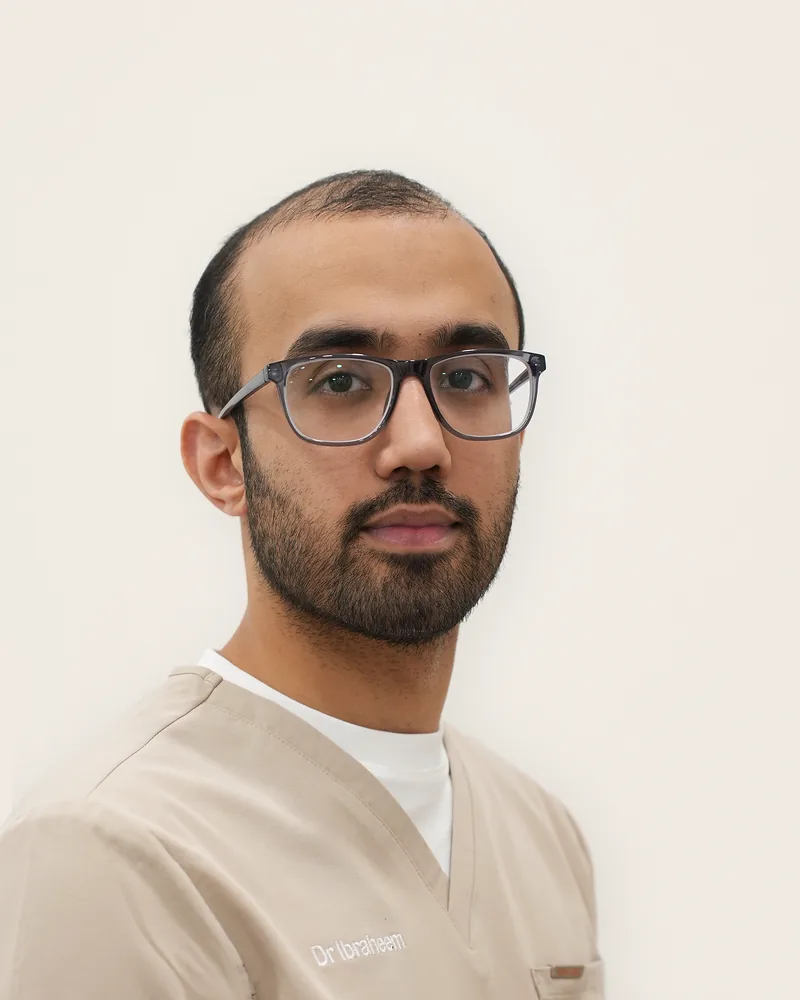
Clinically reviewed by Dr Ibraheem Ijaz, dentist · GDC 301711
Medical disclaimer: This page is for general information only. It does not replace an examination or treatment by a dentist.
Dr Ibraheem Ijaz, principal dentist, reviewed this page. He is a General Dental Practitioner: BDS, BSc (Hons), MSc (Leeds), PG Dip Implant Dentistry, PG Cert Restorative and Aesthetic Dentistry.
Why do teeth move after braces or aligners?
Teeth can move after orthodontic treatment because they tend to return towards where they started, and because tooth positions change with age.
A 2017 review links that return to periodontal, gingival, occlusal and growth factors. The British Orthodontic Society (BOS) says the jawbone and gums can take at least a year to settle, with particular risk in the early months after braces and continuing long-term risk. Relapse is often seen, it says, where teeth started with spaces or were very twisted. Our page on how teeth move covers the tissue changes.
Gum disease is a separate cause. BOS guidance for dentists describes spacing of front teeth after drifting due to periodontal disease. If your teeth have moved and you do not know why, show a dentist. NHS guidance says to see a dentist if your gums bleed when you brush your teeth or eat hard foods, your gums are painful and swollen, or you have bad breath.
Ask for an urgent dentist appointment if you have gum disease and other symptoms such as very sore and swollen gums, teeth becoming loose or falling out, ulcers or red patches in your mouth, or a lump in your mouth or on your lip. If you have no dentist or cannot get an emergency appointment, call 111 or find a dentist near you.
What is the difference between relapse and natural drift?
A 2019 UK clinical guide separates relapse from age-related changes, calling those normal physiological changes that a treated patient might confuse with relapse.
Sources here use these words differently, and none defines "natural drift".
| Term | Who uses it | What it means there |
|---|---|---|
| Relapse, narrow sense | 1983 British Standards definition, quoted in the 2019 guide; BOS; Cochrane 2023 | Original features of the bite returning, or teeth returning to or towards their original position |
| Relapse, broad sense | Later definition quoted in the 2019 guide | Unfavourable change from the final tooth position, which takes in changes with age |
| True relapse | 2019 guide | Tendency to relapse where teeth sit outside a balance of tissue, bite and growth forces |
| Physiological relapse | 2019 guide | Movement retainers resist while gum and periodontal tissues reorganise, which can take up to a year; BOS says teeth can take at least a year for the jawbone and gums to settle |
| Age-related or age changes | 2019 guide; BOS; 2017 review | Normal change with age; BOS mentions crossing over and crowding |
| Drifting | BOS guidance for dentists; BOS FAQs | Front teeth spacing due to periodontal disease; a tooth that may start to drift out of position if a fixed retainer's glue fails |
| Unwanted movement | 2022 fixed retainer review | Movement a fixed retainer may cause, in a different direction from the pre-treatment position; it says this should not count as relapse |
A 1983 study of 65 untreated normal bites, followed to ages 19 to 20, found incisor irregularity rising, with changes similar in nature but lesser in extent than post-retention changes in a treated sample. A 2026 study of 30 untreated people with normal bites, 21 followed from mean age 13 to 62, found lower incisor irregularity and space shortage increasing throughout. Its discussion says this is consistent with physiological forward tooth drift, that such changes make ageing difficult to distinguish from relapse, and that in treated patients age-related lower crowding may result from both.
What do long-term studies show about relapse?
Years after treatment, teeth can shift: late lower incisor crowding can follow, long-term studies suggest, but not predictably in any one person.
A 2007 systematic review (38 studies across several problems, searched to January 2005, at least 5 years after retention) found lower front crowding recurred after crowding was treated, unpredictably for individuals, on limited evidence.
In a 1988 report on 31 four-premolar extraction cases, crowding kept increasing from 10 to 20 years after retention, more slowly than in the first decade, and only 10% were judged to have clinically acceptable lower alignment by then.
A 2017 study of 67 people, a mean 8.5 years after fixed braces with 64% taking part, found lower incisor irregularity rose almost three times more with no lower retainer than with an intact one, with no such upper difference. Mean bite index relapse was 14%, not significantly different by retainer status.
Is relapse difficult to correct?
It may be: BOS's retainer leaflet, reprinted in 2019, warns that movement after retainers are not worn may be difficult to correct.
A 2024 paper on retreatment for relapse and other reasons says it is difficult with limited options, and that such patients have usually had teeth extracted or have gum, jaw joint or other dental problems, often needing multidisciplinary treatment. None of the sources here gives a figure for how much can be corrected.
Questions about this treatment? Book online or call the practice.
What does BOS guidance say about limited orthodontic treatment?
Limited orthodontic treatment aims to address what a patient wants, but not necessarily every aspect of the bite, BOS tells dentists.
Its page covers adults in general, not relapse. Such treatment typically involves only the six front teeth in one or both arches. Patients must be told of any planned slight imperfections in the bite and any need for lifelong aftercare.
If the compromise is too great, it warns of possible tooth wear, jaw joint discomfort or damage to restorations, and calls it inappropriate. A 2017 paper says the essential challenge is patient expectations and acceptance of possible outcomes.
What does BOS say about more comprehensive options?
BOS says limited treatment should be presented alongside all other viable restorative and comprehensive orthodontic options. Adults are often keen to avoid complex, lengthy treatment, it adds.
Restored teeth, especially crowns and bridges, can make treatment more challenging for some adults, BOS adds. For limited treatment, as with all orthodontic treatment, it says the risks of decalcification, periodontal disease, root resorption, devitalisation and relapse must be fully discussed.
How is relapse risk reduced after treatment?
Long-term retention is advocated to reduce the risk, a 2017 review says, because clinicians cannot predict who will relapse.
A 2016 technique paper's background says failure of a bonded retainer at one or two teeth exposes them to relapse. Our page on keeping your teeth in their new position covers retainer types, wear, replacement and lifespan.
Who is orthodontic treatment at Deepcar Dental Care for?
Orthodontic treatment at Deepcar Dental Care is for adults only.
Our page on orthodontics at Deepcar Dental Care covers orthodontic treatment at the practice.
Frequently asked questions
Do I need braces again if my teeth have moved?
No source here sets a rule. For adults generally, BOS tells dentists limited treatment may be appropriate for cosmetic concerns if other viable options are presented and diagnosis is complete. In a 2022 study of 36 people seeking retreatment and 36 first-time patients, neither group showed objective treatment need, though all had some bite traits that clinically justified treatment.
Is treatment for relapse available on the NHS?
Unlikely, going by general guidance. BOS's retainer leaflet, reprinted in 2019, says movement after retainers are not worn is unlikely to be treated under the NHS. BOS also says adults are not usually eligible for NHS treatment, and the NHS says adults usually pay privately for braces.
Can teeth move with a fixed retainer still in place?
Yes. One study calls unexpected complications, such as canines tilting in opposite directions, relatively rare: 38 of 3,500 patients screened with lower fixed retainers. In a 2007 report of 21 patients with unexpected changes and lower spiral wire retainers, almost half were assessed as needing retreatment.
Do teeth move back after clear aligners too?
They can. A review searched to February 2025 found limited evidence of similar stability to braces, with mixed studies and short follow-ups. A 2024 review of three studies at high or moderate risk of bias says there appears to be no major difference: two found no significant difference, the third (22 patients) more relapse in total alignment with aligners.
Do lower front teeth crowd more with age?
Studies of untreated people point that way. A 2009 Swedish study of 436 people with normal bites, aged 5 to 31, said ongoing arch change could be interpreted as biological migration, with front crowding especially in the lower jaw, even with congenitally missing wisdom teeth.
Book a consultation.
Online in under a minute, or call and speak to a real person.
For other bite and alignment problems, browse this section. See our patient reviews page.
334 Manchester Road
Deepcar, Sheffield S36 2RH
0114 288 2121
Contact us
Opening hours
Open 8am to 8pm, seven days
Free parking at the door