Emergency dental conditions
Dental emergency conditions in Sheffield: what is behind the pain
Pain is the symptom. Underneath it is a small number of conditions, each with its own cause and its own fix. Knowing which one you have decides the treatment.
Condition guides
What’s causing the problem?
Cracked tooth
Symptoms, risks and emergency treatment for deep cracks.
Read moreFractured cusp
When part of the tooth breaks away.
Read moreGum abscess
Pus in the gums and how it is drained.
Read morePericoronitis (wisdom tooth infection)
Infection around an erupting wisdom tooth.
Read moreRoot fracture
Cracks below the gum line and what they mean for the tooth.
Read moreTooth trauma
Injuries from falls, sport and accidents.
Read more Clinically reviewed by Dr Ibraheem Ijaz, Principal Dentist · GDC 301711 · Last reviewed April 2026
Pulpitis: the nerve inflamed, reversible or not
The pulp is the soft tissue in the middle of the tooth: nerve, blood vessels and a little connective tissue, in a chamber the width of a hair with hard walls all round. When decay, a crack or a deep filling irritates it, it swells, and because the walls do not give, the swelling squeezes its own blood supply. That is pulpitis.
Reversible pulpitis hurts sharply with cold and stops within seconds. Remove the cause, place a filling, and the nerve recovers. Irreversible pulpitis lingers for more than 10 to 30 seconds after hot or cold, aches on its own and wakes you at night. The nerve will not recover; it dies, and usually turns into an abscess a few weeks later. The choices are a pulpectomy today followed by root canal treatment, or an extraction. What it feels like is described in severe toothache.
Two kinds of abscess, and why the difference changes the treatment
A periapical abscess starts inside the tooth. The nerve has died, bacteria multiply in the empty canal, and infection pushes out through the root tip into the bone. The tooth is tender to tap, may feel high when you bite, and often no longer responds to cold at all because there is no living nerve left. The fix is to drain through the tooth by opening the canal, or to remove the tooth. Antibiotics on their own do not reach it.
A periodontal abscess starts outside the tooth, in a deep gum pocket. The nerve is usually alive, the tooth responds normally to cold, and the swelling sits on the gum beside the tooth rather than over the root tip. It is drained through the pocket and cleaned, and the tooth is often kept. Our gum abscess guide covers both types and how they are told apart, and incision and drainage explains what draining involves. Either can produce a swollen face, and either, if it spreads towards the eye or the throat, becomes a hospital matter.
Pericoronitis: the wisdom tooth gum flap
A lower wisdom tooth that is only half through leaves a flap of gum over the back of it. Food and bacteria collect under the flap, the upper wisdom tooth bites down on it, and the flap becomes inflamed and infected. That is pericoronitis: pain at the back of the jaw, a bad taste, difficulty opening wide, sometimes a tender gland under the jaw. It is common in the late teens and twenties and tends to flare when you are run down.
First-line treatment is irrigation under the flap, warm salt water and chlorhexidine at home, and sometimes smoothing or removing the upper tooth that is biting on it. Antibiotics are added only when the infection is spreading. Repeated episodes usually mean the wisdom tooth should come out; see the pericoronitis guide and our wisdom teeth page.
Cracks, fractured cusps and root fractures
Cracks are the most missed cause of tooth pain because they rarely show on an X-ray. Cracked tooth syndrome is a crack in the crown of a heavily filled or heavily clenched tooth: sharp pain on biting, especially on letting go, sometimes a jolt with cold, and nothing to see. We find it with a bite test on each cusp and a bright light shone through the tooth. A crown holds the crack together; caught early, the nerve is spared. See cracked tooth.
A fractured cusp is a crack that has completed: a corner of the tooth breaks off, usually beside a large filling. It feels dramatic but is often the easiest of the three to fix, with a filling or a crown, because the crack has left with the fragment. See fractured cusp.
A root fracture is a crack below the gum. A horizontal root fracture after a knock can heal if the tooth is splinted. A vertical root fracture running down the length of the root cannot, and almost always means extraction, sometimes followed by an implant. The root fracture guide explains why, and why a CBCT scan is sometimes the only way to see one.
Trauma: knocked, loosened and displaced teeth
A blow to the mouth can chip a tooth, loosen it in its socket, push it in, out or sideways, or knock it out altogether, and it can fracture the root or the surrounding bone at the same time. Each is managed differently and the first few hours matter. A tooth pushed out of position is repositioned and splinted. A knocked-out adult tooth is replanted, ideally within an hour, having been kept in milk. Baby teeth are never replanted.
Every injured tooth is X-rayed for a root fracture, tested for a living nerve, and reviewed over the following months, because the nerve can die quietly weeks later and the tooth darkens. The tooth trauma guide covers what to do at the scene and what follow-up to expect. Symptoms are described in knocked-out tooth and loose adult tooth.
How we tell these conditions apart in the chair
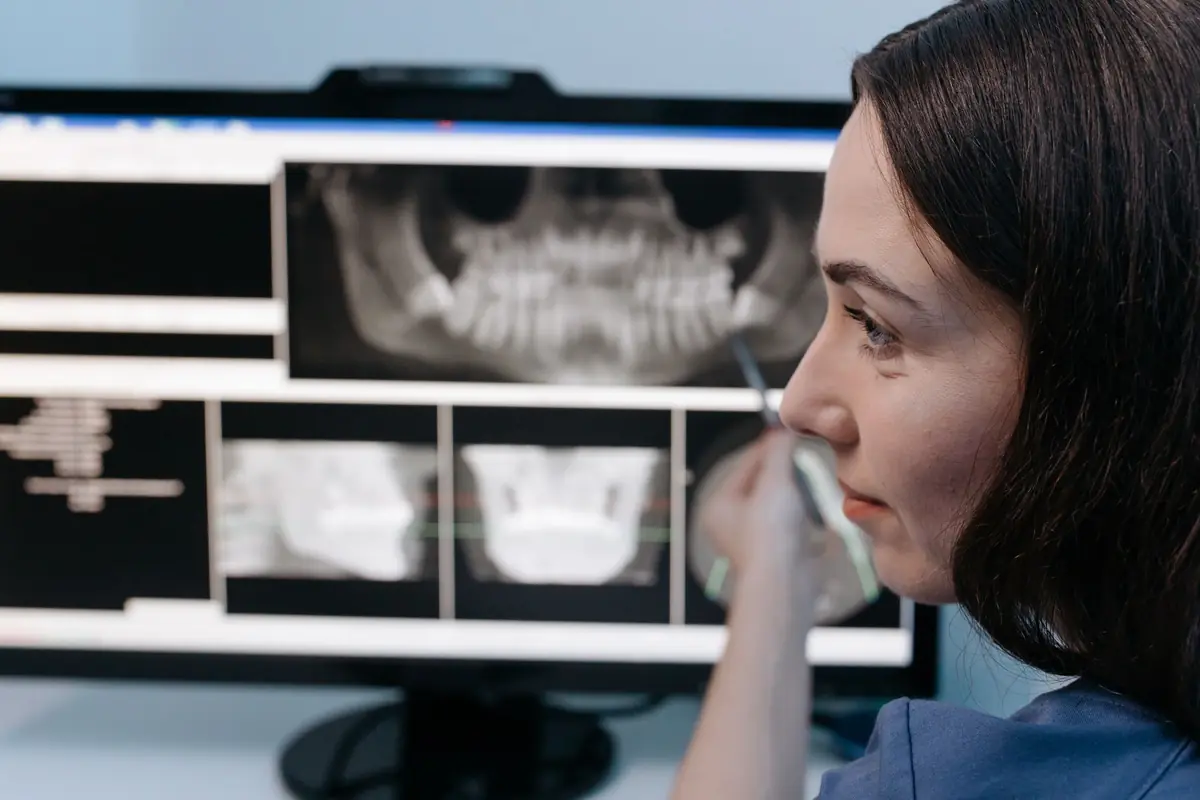
Diagnosis at the £30 emergency examination is a sequence of small tests. Cold on the tooth: a sharp short response means a live nerve, a lingering one means irreversible pulpitis, none means a dead nerve. Tapping: tenderness means the ligament or bone is involved. Pressing the gum: a periodontal abscess will often ooze. Biting on a plastic wedge: a crack gives a sharp pain on release. A pocket probe around the tooth separates a gum abscess from a root abscess. Then a digital X-ray, and for anything hidden, a CBCT scan on site.
Two conditions can look identical and need opposite treatment, which is why we do not diagnose over the phone and why we do not start with antibiotics. Once the condition is named, the treatments guides set out what we do for each and what it costs, and the symptoms guides cover what you might notice next.
Questions, answered
Common questions
What is the difference between pulpitis and an abscess?
Pulpitis is inflammation of the living nerve inside the tooth; it reacts to hot and cold. An abscess is infection that has spread from a dead nerve into the bone around the root, or from a gum pocket; the tooth is tender to tap and there may be swelling.
Can a cracked tooth be saved?
Usually, if the crack is in the crown of the tooth and caught before it reaches the nerve or the root. A crown holds it together. A crack running down the root generally means the tooth has to come out.
Is a gum abscess the same as a tooth abscess?
No. A gum (periodontal) abscess starts in a pocket beside the tooth and the nerve is usually alive; a tooth (periapical) abscess starts from a dead nerve at the root tip. They are drained differently and the gum type often lets the tooth be kept.
What is pericoronitis and does it need antibiotics?
It is infection of the gum flap over a partly erupted wisdom tooth. Cleaning under the flap and salt-water or chlorhexidine rinses settle most cases; antibiotics are only added if the infection is spreading or you are unwell with it.
How do dentists diagnose a dental emergency?
With cold, tapping, bite and gum-pocket tests on the suspect teeth, then a digital X-ray and, where needed, a CBCT scan. The pattern of results points to one condition, and the treatment follows from that.
Will a dead tooth always form an abscess?
Not always, and not immediately, but a dead nerve is a sealed space full of bacteria with no defence, so most do eventually. That is why a tooth that has gone quiet after a long ache still needs root canal treatment or removal.
In pain? Don’t wait
Same-day emergency appointments, seven days a week.
£30 emergency examination including X-rays. Call now and a real person answers, or grab a slot online.
334 Manchester Road, Deepcar, Sheffield S36 2RH · Free parking