Emergency dental conditions
Root fracture: horizontal and vertical breaks below the gum
A root fracture is a break in the part of the tooth you cannot see. Whether the tooth can be kept depends almost entirely on which way the break runs.
 Clinically reviewed by Dr Ibraheem Ijaz, Principal Dentist · GDC 301711 · Last reviewed April 2026
Two very different injuries with the same name
The root is the two-thirds of a tooth buried in the jawbone, held there by a thin ligament. Break it and there are two quite separate stories.
A horizontal root fracture is an injury. A blow to the mouth, from a fall, a ball, a bike handlebar or a fist, snaps a front tooth across its root the way a branch snaps. The crown stays in place, held by the gum and the bone around the lower fragment. These mostly happen to upper front teeth in children, teenagers and people who play sport, and they often heal, because the two halves are still in a living socket with a blood supply.
A vertical root fracture is a fatigue failure. A crack runs lengthways down the root, splitting it from the inside. It is almost always a tooth that has already had root canal treatment, often one with a post inside it, and it creeps rather than snaps: months or years of chewing on a brittle, hollow root until it gives. There is no blood supply to heal it and, once bacteria are in the crack, the bone beside it melts away. These nearly always end in extraction.
Both are different again from a crack that starts at the biting surface and travels downward, which is covered in our guide to a cracked tooth.
Symptoms of a broken root
After a knock, a horizontal fracture usually shows as:
- A front tooth that is loose or feels wobbly when you touch it with your tongue, in a way the neighbouring teeth are not.
- The tooth sitting slightly higher, lower or further out than before, so it hits first when you close.
- Pain on biting and tenderness when the tooth is tapped.
- Bleeding from the gum line around it in the first hours.
A vertical root fracture is quieter and much harder to pin down. Typical clues are a dull ache on chewing in a root-filled tooth that had been fine for years, a small gum boil that keeps returning beside the same tooth, a deep pocket on one side of the root that the hygienist finds, or a crown that has come loose more than once. Many people have had the tooth re-root-treated or the crown recemented before anyone suspects the root itself.
If a tooth has become loose without any injury, our page on a loose adult tooth walks through the other causes, including gum disease, which is more common than a fracture.
Why root fractures are hard to spot
A standard dental X-ray is a flat picture of a three-dimensional tooth. A horizontal fracture shows as a dark line across the root, but only when the X-ray beam runs roughly parallel to the break; tilt the angle by a few degrees and the line disappears. So at the emergency examination we take more than one view at different angles, and this is included in the £30 fee.
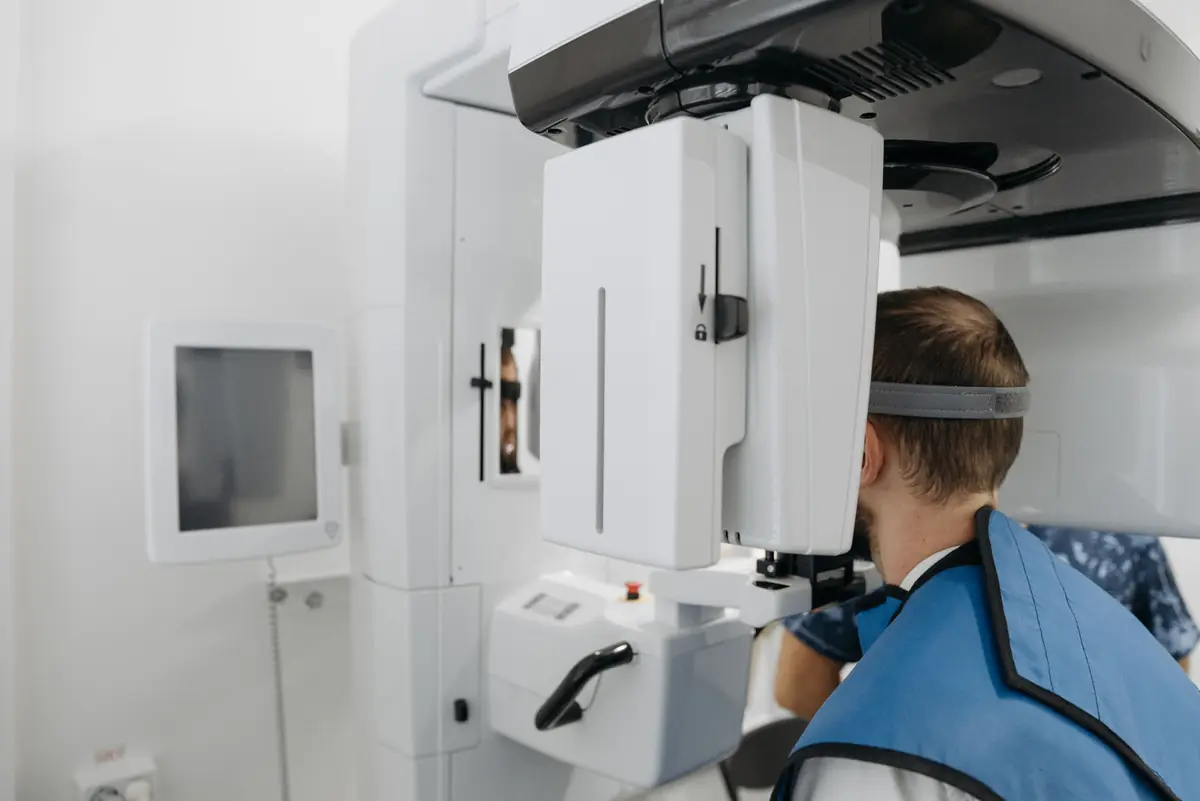
Vertical fractures are worse. The crack is often thinner than the resolution of the X-ray, so we look instead for its consequences: a J-shaped or halo-shaped shadow of bone loss hugging one side of the root, and a narrow, deep gum pocket in exactly one spot. Where the picture is still unclear, a CBCT scan (£150) gives a three-dimensional image in slices thinner than a millimetre. We have the scanner in the practice, so there is no referral or wait. Occasionally the only certain way to confirm a vertical fracture is to lift a small flap of gum and look at the root directly.
Horizontal fractures after a knock: splinting and healing
Treatment follows the guidelines of the International Association of Dental Traumatology. If the crown fragment has moved, we numb the tooth and ease it back into position, then bond a thin, flexible splint of wire and composite to it and the teeth either side. The splint holds the two halves still so that they can heal, in the same way a fractured arm is held in a cast. The procedure is described on our page on splinting a loose tooth.
How long the splint stays on depends on where the break is. A fracture in the middle or towards the tip of the root is usually splinted for about four weeks. A fracture up near the gum line, in the top third of the root, is the least stable and is splinted for up to four months. The tooth is then reviewed at intervals for at least a year with X-rays and nerve tests, because the nerve in the crown fragment can die months later. If it does, the crown portion alone is root-treated; the tip fragment usually stays healthy and is left alone.
The honest outlook: fractures in the lower two-thirds of the root heal in the majority of cases and the tooth can last for many years. Fractures at the very top of the root, close to the gum, are much less predictable and some of these teeth are eventually lost. We will tell you which you have on the day.
Vertical root fractures: why extraction is usually the answer
There is no reliable way to repair a root that has split lengthways. Adhesives have been tried; the bone beside the crack does not recover and the infection returns. In a single-rooted tooth the tooth is removed. In a molar, if only one root is split, it is occasionally possible to remove that root and keep the rest of the tooth, but this is uncommon and we would only suggest it where the remaining part is sound.
The good news is that the extraction is usually straightforward, the ache and the recurring gum boil stop immediately, and the earlier the tooth comes out, the more bone is preserved for whatever replaces it. Waiting while the infection eats away at the socket wall is the main thing that makes a later implant harder.
All fees are put in writing and agreed before treatment starts. 0% finance over 6 to 18 months and longer terms up to 60 months at 10.9% APR representative are available through Tabeo, subject to status.
| Treatment | Fee (from) |
|---|---|
| Emergency examination including X-rays | £30 |
| CBCT 3D scan where the X-rays are inconclusive | £150 |
| Repositioning and splinting a horizontally fractured tooth | Quoted at the examination |
| Root canal treatment of the crown fragment if the nerve dies | £450 |
| Extraction of a vertically fractured tooth | £120–£260 |
| Surgical extraction where the root is very brittle | Quoted at the examination |
| Dental implant to replace the tooth | £2,400 |
Replacing a tooth that cannot be saved
Losing a tooth to a root fracture is a blow, particularly when it is a front tooth or a tooth you have already invested in. The options are the same as for any missing tooth: a dental implant, a bridge carried on the neighbouring teeth, or a denture. Dr Ibraheem Ijaz has placed over 200 implants since 2022 and can often plan the implant from the same CBCT scan used to confirm the fracture. Where the socket has lost bone, the implant may be placed a few months after extraction once it has healed, sometimes with a bone graft. Our page on a missing tooth compares the choices.
What to do while you wait to be seen
- 01After a knock, do not push, wiggle or bite on the loose tooth. If it has moved position and you can gently guide it back with a clean finger, do so; otherwise leave it.
- 02Get here quickly. A displaced tooth is far easier to reposition in the first hour or two, before the blood clot around it sets.
- 03If a tooth has come out completely, that is a different emergency: follow our guidance on a knocked-out tooth, keep it in milk and ring immediately.
- 04Soft food only, and chew on the other side.
- 05Paracetamol and ibuprofen as directed on the packet. Do not rub anything on the gum.
- 06For a suspected vertical fracture in an old root-filled tooth, warm salt-water rinses keep a gum boil draining and comfortable until we can look at it.
Questions, answered
Common questions
Can a fractured root heal?
A horizontal fracture from an injury often can, if the tooth is repositioned and splinted promptly, because the root sits in a living socket. A vertical fracture running down the length of the root cannot heal.
How do you know if a tooth root is fractured?
By combining a tap test, looseness, gum probing and X-rays taken at more than one angle. Where those are inconclusive a CBCT scan shows the root in three dimensions and often settles it.
Does a root fracture always mean losing the tooth?
No. Most horizontal fractures from a knock are splinted and kept. Vertical fractures in root-treated teeth almost always mean extraction because there is no way to repair a root split lengthways.
How long does a splint stay on?
Around four weeks for a fracture in the middle or tip of the root, and up to four months for a fracture close to the gum line, which is the least stable.
Why did my root-filled tooth crack?
A root-treated tooth is drier and more brittle than a live one, and if a post has been fitted the root wall around it is thinner still. Years of chewing can gradually split it. A crown placed soon after root treatment reduces the risk.
What does treatment cost?
The emergency examination with X-rays is £30 and a CBCT scan £150 if needed. Splinting is quoted at the visit. Extraction is £120–£260 and an implant to replace the tooth from £2,400, with 0% finance available.
Should I go to A&E for a root fracture?
Not for the tooth alone. Go to A&E if you were knocked out, are confused, vomiting or drowsy after the injury, have a suspected broken jaw, or have bleeding that will not stop. Otherwise ring us and we will see you the same day.
In pain? Don’t wait
Same-day emergency appointments, seven days a week.
£30 emergency examination including X-rays. Call now and a real person answers, or grab a slot online.
334 Manchester Road, Deepcar, Sheffield S36 2RH · Free parking