Underbite: When the Lower Teeth Sit in Front
For adults asking about an underbite (Class III malocclusion): how a dental underbite differs from a skeletal one, why age matters, and when jaw surgery and referral are considered. Across adult orthodontics, a small group find braces alone will not achieve the improvement they need and also have jaw surgery, the British Orthodontic Society (BOS) says.
5.0 from 550+ Google reviews
Open 8am to 8pm, seven days
Free parking at the door
CQC & GDC registered
No referral needed
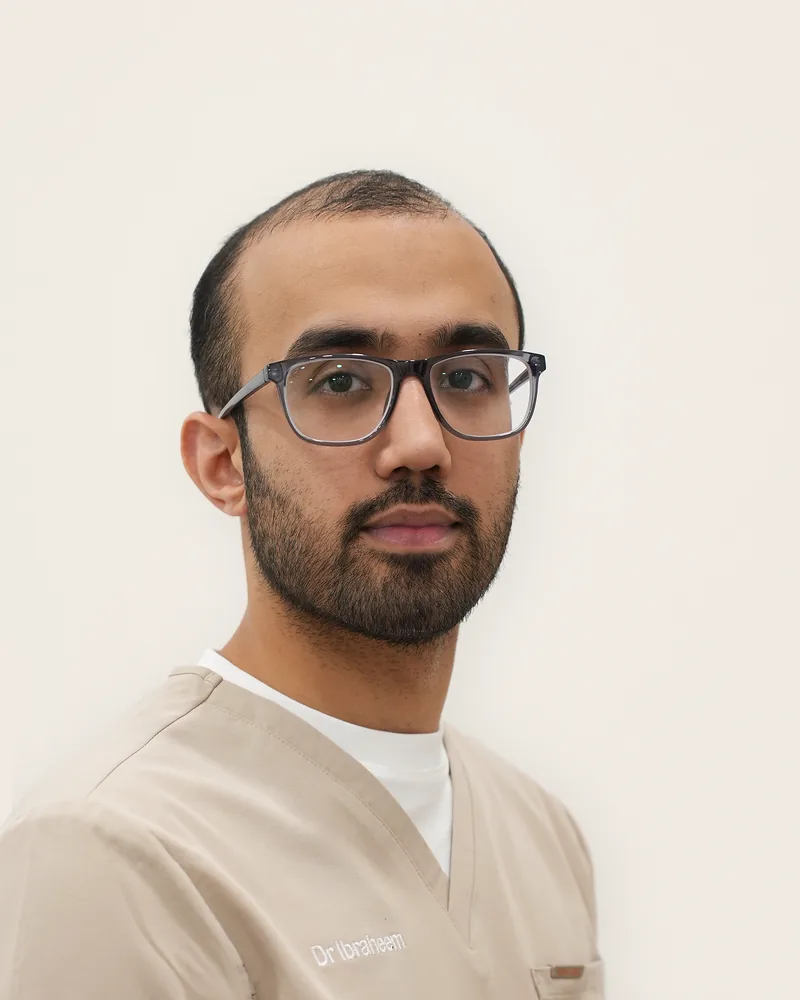
Clinically reviewed by Dr Ibraheem Ijaz, dentist · GDC 301711
Medical disclaimer: This page is for general information only. It does not replace an examination or treatment by a dentist.
Dr Ibraheem Ijaz, principal dentist, reviewed this page. He is a General Dental Practitioner: BDS, BSc (Hons), MSc (Leeds), PG Dip Implant Dentistry, PG Cert Restorative and Aesthetic Dentistry.
What is an underbite?
An underbite, or Class III malocclusion, is a bite where the lower front teeth sit in front of the upper ones.
A 2024 Cochrane review lists reverse bite and anterior crossbite as other terms for it. MedlinePlus (US) calls Class 3 prognathism or underbite, where the lower jaw juts forward.
Cochrane says it can result from genetic factors, environmental influence or both.
What is the difference between a dental and a skeletal underbite?
A dental underbite comes from tooth position and a skeletal underbite from jaw position; Cochrane says an underbite may be due to either or both.
| Dental | Skeletal | |
|---|---|---|
| What is out of place | Upper front teeth tipped back, lower front teeth tipped forwards, or both | Upper jaw too far back (maxillary retrusion), lower jaw too far forward (mandibular prognathism), or both |
Why does age matter for an underbite?
Age matters because skeletal growth is complete in adults, so correcting the jaws through growth is no longer feasible, a 2026 narrative review says.
In children, orthodontic treatment can aim to modify jaw growth (growth modification), Cochrane says.
Jaw (orthognathic) surgery usually follows the end of growth, a 2013 Royal College of Surgeons of England (RCS England) guide says.
What does a Cochrane review say about underbite treatment in children?
Cochrane's 2024 review found orthodontic treatment for Class III improved a child's bite and jaw relationship immediately afterwards, but how long this lasts is uncertain.
Its search, to January 2023, found 29 randomised trials in 1,169 children aged 5 to 13, all at high risk of bias. Against no treatment, certainty for that immediate result was moderate for non-surgical treatments and low, from one study of 30 children, for treatments placed under the gums.
One study, of one appliance, measured longer-term outcomes. The benefit was reduced at three years and appeared lost by six, though clinicians judged treated children less likely to need jaw surgery in adulthood. That was perceived need, not surgery carried out, and the authors have low confidence in these findings. Treatment can be invasive, expensive and time-consuming, they add.
To ask about orthodontic treatment, book online or call 0114 288 2121.
Can braces fix an underbite in an adult?
In mild to moderate cases they may mask it: camouflage treatment moves the teeth to compensate for a jaw difference without correcting the jaws.
A 2022 review of six retrospective studies in borderline Class III, searched to October 2021 and of moderate quality, concluded surgery moved the jaw bases, while camouflage had a clinically insignificant effect on them. Of four studies testing significance, camouflage tilted lower front teeth back in four and upper ones forward in two; in surgery groups, each tilted forward in three.
A 2026 narrative review concluded camouflage appears effective for mild to moderate Class III in adults when tooth movement stays within biological limits, but says the evidence is limited and mostly low quality. Moving teeth too far may increase gum and bone problems and reduce stability, and a prominent lower jaw or a set-back upper jaw may persist. One study it cites found relapse in 11 of 36 patients, mean age 20, after at least 3 years, counting front-teeth overlap under 1 mm or a Class III canine relation.
Another 2022 review of six retrospective studies, searched to September 2021, found the evidence insufficient to identify an X-ray threshold for choosing camouflage or surgery. The decision in borderline cases also involves clinical judgement and the patient's wishes, it says. For the biology, see how teeth move.
When may an underbite need jaw surgery?
RCS England's 2013 guide says people with significant dento-facial deformities causing functional or psycho-social problems should be referred for assessment.
A 2019 UK audit, in which half of first-clinic patients had skeletal Class III, reports these criteria for NHS funding as they stood in the Chief Dental Officer's 2017 interim guidance:
- a score of 4 or 5 on the Index of Orthognathic Functional Treatment Need (IOFTN)
- functional symptoms with an important impact on quality of life, normally apparent within 5 years of skeletal maturity
- a multidisciplinary team confirming that orthodontic treatment alone cannot adequately correct those symptoms
- skeletal maturity reached, though the audit says its definition is unclear
- jaw surgery low priority, on insufficient evidence of functional improvement, for speech problems and jaw pain, particularly at the jaw joint
The IOFTN applies to malocclusions not amenable to orthodontic treatment alone because of skeletal deformity. A reverse overjet (lower front teeth in front of the upper) of 3 mm or more scores 5, very great need. Under 3 mm it scores 4 with functional difficulties and 3 without. It covers functional need only and should be used with psychological and other clinical indicators.
What referral pathway does a 2013 guide describe for jaw surgery?
In general, a patient has a first assessment, then goes to a multidisciplinary facial deformity (orthognathic) clinic, RCS England's 2013 guide says.
The guide covers jaw deformities generally, not only skeletal Class III. Its stages, based on individual need, are:
- orthodontics before surgery, generally 18 to 24 months with visits every four to six weeks
- surgery as an inpatient, typically around two nights, with recovery typically two weeks for one jaw and three weeks for both
- orthodontics after surgery, six-weekly for up to twelve months, then review for at least two years after braces come off
What are the risks of jaw surgery?
Jaw surgery risks include swelling, bleeding, nerve damage and infection, and the orthodontic stages can affect oral health, RCS England's 2013 guide says.
RCS England calls serious complications relatively rare. One study it cites, of 3,236 patients, noted reversible lip sensory loss in 19%, irreversible sensory loss in 2% and infection in 2%. A 2026 review of 47 studies (5,406 patients) put altered sensation one year after lower jaw splitting surgery at 21% (likely range 13% to 32%), higher with older age in five of nine studies, and says assessment needs standardising. A 2021 review of nine lower jaw setback studies found good skeletal stability: 0.9 to 1.63 mm relapse in four reaching two years, and calls nine too few for clinical guidance.
Who is orthodontic treatment at Deepcar Dental Care for?
Orthodontic treatment at Deepcar Dental Care is for adults only.
See orthodontics at Deepcar Dental Care for the treatments offered.
Frequently asked questions
Does jaw surgery change how the face looks?
It can. BOS says some jaw surgery is planned to improve the bite with minimal change to facial appearance, while in other cases, such as a prominent lower jaw, the change is more noticeable. One borderline Class III study in a 2022 review found profile attractiveness improved with camouflage and with surgery, ending similar; the surgery group started lower.
Is jaw surgery only for young adults?
Mostly, but not only. RCS England's 2013 guide says older patients also present with worsening symptoms and request treatment. In a 2019 UK audit, the 2,263 patients at a first jaw surgery clinic had a mean age of 22 and the oldest was 58 years 10 months.
Is jaw surgery available on the NHS?
It can be. NHS England's 2023 South West guidance says someone over 18 with a significant skeletal discrepancy may be eligible for hospital treatment with a functional need (IOFTN) score of 4 or 5. BOS's orthodontic referral sheet says adults may qualify for NHS treatment, for example if they require complex multidisciplinary care.
Can an underbite affect eating or speech?
It can. Cochrane's background says people with prominent lower front teeth often report problems eating and occasionally problems with speech. If you have either, show a dentist. On jaw surgery for speech, RCS England's 2013 guide found little reliable evidence, while a 2026 observational study of 67 Class III patients reports less distorted speech 9 to 14 months afterwards.
How common is an underbite?
About 6% of people with adult teeth have Class III, on one global estimate. A 2018 review of 53 population studies averaged 5.93%, ranging from 1% to 19.9% by study. For adult teeth, a reverse overjet across all four upper front teeth averaged 4.56%.
Book a consultation.
Online in under a minute, or call and speak to a real person.
For other bite and alignment problems, browse this section. See our patient reviews page.
334 Manchester Road
Deepcar, Sheffield S36 2RH
0114 288 2121
Contact us
Opening hours
Open 8am to 8pm, seven days
Free parking at the door