Your Scan and Digital Treatment Plan
For adults thinking about clear aligners, this page covers the steps from digital scan to first aligner: how a 3D plan is built, what the simulation shows and how a plan is approved. Studies comparing plans with achieved tooth positions found differences of varying size, so the simulation shows planned movement, not a promised result.
5.0 from 550+ Google reviews
Open 8am to 8pm, seven days
Free parking at the door
CQC & GDC registered
No referral needed
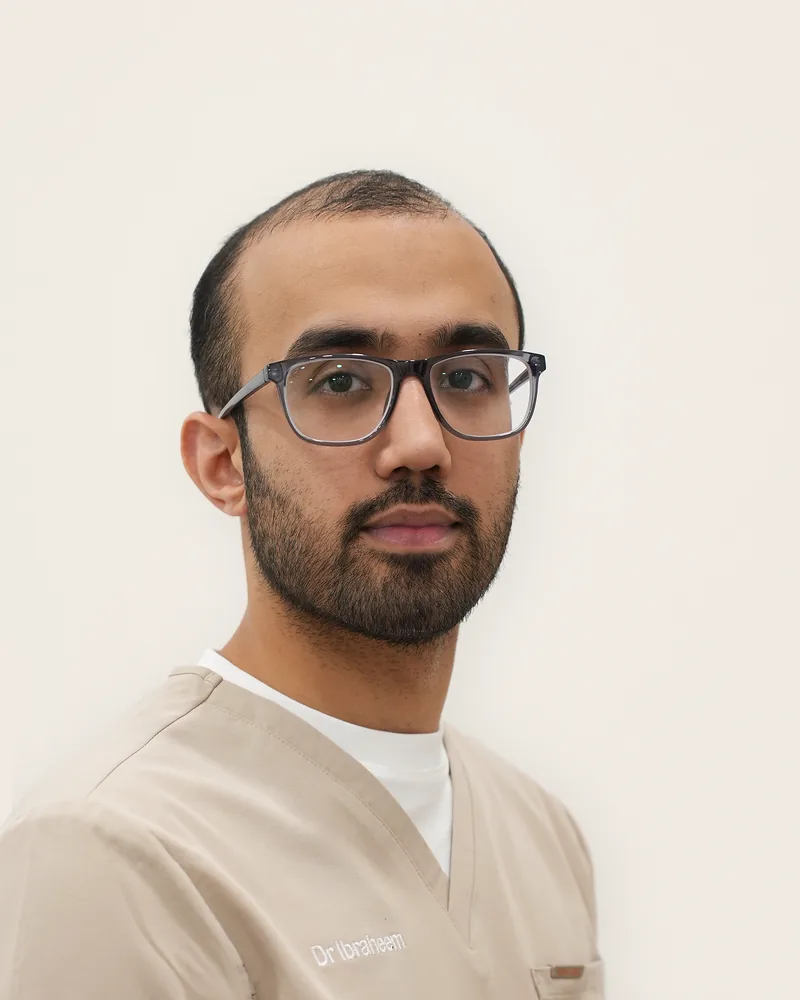
Clinically reviewed by Dr Ibraheem Ijaz, dentist · GDC 301711
Medical disclaimer: This page is for general information only. It does not replace an examination or treatment by a dentist.
What does the scan record?
The scan records your teeth and gums as a 3D digital model, the starting point for an aligner plan. A 2023 review of aligner materials says this record comes from an intraoral scanner or from digitally scanning a putty impression.
A 2017 narrative review calls intraoral scanners very useful in orthodontics for diagnosis and treatment planning, and a starting point for custom devices such as aligners. Our page on digital dentistry covers how scanners work.
A scan is a record, not an assessment. The General Dental Council says judgements on whether a course of orthodontic treatment is suitable "must be based on a full assessment of the patient's oral health", and that "at present, there is no effective substitute for a physical, clinical examination as the foundation for that assessment". Which problems aligners can suit is covered if you browse the suitability section.
How is a digital treatment plan built?
As general guidance, the digital scan is used to build a 3D treatment plan. You then see the planned tooth movement as a simulation, and the aligners are made to match the plan. Your consultation confirms this.
A 2023 review of aligner materials describes how software separates the crown of each tooth on the scanned model, then moves the teeth in steps towards the planned end positions, creating a virtual model for each stage. A 2026 single-author narrative review, with no formal grading of studies, says movement is staged at approximately 0.2 mm or 2 degrees per aligner.
In a 2025 computer study of 44 adults' scans, the same tooth movements entered into four programs gave different final setups, more so in severe crowding (over 5 mm) than in moderate crowding (2.5 to 5 mm), which the authors attribute to each program's algorithm, segmentation method and rotation centre.
What does the simulation show?
In general, the simulation shows the teeth moving, stage by stage, from their current positions to the planned end positions.
The authors of a 2025 computer study of planning programs noted that roots are absent from intraoral scans, so the movements in their study rested on the crowns alone, which could pose significant errors where root and crown long axes differ. A 2023 review notes that roots can also be visualised by overlaying CT scan data.
Does the simulation show your final result?
Not necessarily: studies comparing plans with achieved positions found that teeth did not always reach the positions the simulation showed, by amounts that varied.
In a 2017 retrospective study of 30 patients at one US university (mean age 21.6, average crowding 2 mm), treated with one aligner system and no extractions, all finishing without additional aligners, final positions differed significantly from the plan for every tooth type except the upper lateral incisors, upper canines and upper first premolars. Only one difference passed the authors' clinical threshold of 0.5 mm or 2 degrees.
They concluded that predicted positions were generally achieved with high accuracy in non-extraction cases, while noting that upper arch widening may fall short, lower incisors tend to sit further up, towards the bite, than predicted, rotation of rounded teeth may be incomplete, and molar torque may fall short, with the upper second molars often tilting outwards (crown torque) more than predicted by a clinically relevant amount.
They named their impression-based models as a possible source of error.
A 2026 retrospective study at one hospital in China instead measured the share of each planned movement achieved at the end of the first series of aligners, before any refinement. In 40 adults (mean age 27.8, Class I, mean crowding 3.5 mm upper and 3.6 mm lower), none having extractions other than wisdom teeth and all treated with one aligner system, every front tooth differed significantly from the plan in all four movement types, with overall accuracy reported at 50.3%.
The authors found upper distal tipping and canine lingual tipping more predictable and upper incisor intrusion still challenging, and advised additional refinements for front-tooth alignment. Limits they named: crowns were measured, not roots; the retrospective design gave limited control over compliance and took no account of overcorrections or additional aligners; and system updates during 2019 to 2024 mean the results may not match the current version of the system.
A 2021 systematic review of seven observational studies of rotation, six of them of one aligner system, searched to August 2020, pooled two or three studies per tooth group: accuracy ranged from 47.9% of the predicted rotation for upper canines (three studies) to 70.7% for lower incisors (two studies). The authors concluded that accuracy was low for front teeth and premolars, and that the evidence, of low to moderate quality, did not support strong confidence in the estimates. Its findings cover rotation in certain tooth groups only and may not reflect newer materials or adjuncts.
A 2026 single-author narrative review concluded that clinicians must interpret digital plans as geometric templates rather than literal prescriptions, adapting and overcorrecting treatment to each person's biological response.
Questions about this treatment? Book online or call the practice.
How is a plan approved?
General Dental Council standards say: "You must obtain valid consent before starting treatment, explaining all the relevant options and the possible costs". They add that patients must be given sufficient information, and a reasonable amount of time to consider it, in order to make a decision.
As general guidance, you see how long treatment is planned to take on the 3D plan before committing, and your consultation confirms this.
How are the aligners made?
As general guidance, the aligners are made to match the plan. A 2023 review of aligner materials describes the widely adopted method: each stage's virtual model is made into a physical model, mainly by 3D printing; an aligner for that stage is thermoformed (moulded from heated plastic sheet) over it, then trimmed and polished.
Where a plan uses attachments, small composite resin shapes are bonded to some teeth to help the aligners grip and move them. They are explained under aligner attachments. If teeth lag behind the plan, further aligners can be planned, as explained under aligner refinement.
What are the steps from scan to first aligner?
In general, the steps come in this order:
- Scan: a 3D digital model of the teeth and gums is recorded.
- Plan: the teeth are moved on the model, in stages, to planned end positions.
- Simulation: the planned movement is shown to you.
- Approval: under GDC standards, your valid consent is needed before treatment starts.
- Manufacture: an aligner is made for each stage of the plan.
- First aligner: treatment begins with the first aligner in the series.
Later stages, such as daily wear, are among the options in this section.
When should you speak to your dentist about your plan?
Before agreeing to a plan, raise anything in the simulation you do not understand or did not expect with your dental team.
During treatment, tell the team treating you if an aligner stops fitting closely. A 2026 narrative review describes this tracking loss as a gap between aligner and tooth that can grow with each new aligner.
Who is orthodontic treatment at Deepcar Dental Care for?
Orthodontic treatment at Deepcar Dental Care is for adults only. Aligner treatment at the practice is described on the main clear aligner therapy page.
Frequently asked questions
Why might your teeth not follow the plan exactly?
Teeth move by a biological process that planning software does not fully model. A 2026 single-author narrative review explains that software stages movement by geometry, without accounting for bone density, gum condition, age, genetics or medication, so two people with identical problems and identical aligner sequences may respond very differently.
Is an intraoral scan more comfortable than an impression?
A 2017 narrative review says optical impressions, or scans, reduce patient stress and discomfort. It calls this their most important advantage over conventional impressions, especially for the many patients with anxiety and a strong gag reflex who do not tolerate conventional impressions, and says "a full-arch scan may take 3–5 min", similar to a conventional impression.
Can a plan change once treatment has started?
Yes, with your consent. GDC guidance calls consent a process, not a one-off event, with patients kept informed about the progress of their care. If a dental professional needs to change a patient's agreed treatment, they must obtain the patient's consent to the changes and record it.
Book a consultation.
Online in under a minute, or call and speak to a real person.
Reviews from patients of the practice in general are on our patient reviews page.
The practice is at 334 Manchester Road, Deepcar, Sheffield, S36 2RH. It is about 15 minutes by car from Sheffield city centre, with free parking directly outside. The page on clear aligners in Sheffield has more on getting here.
334 Manchester Road
Deepcar, Sheffield S36 2RH
0114 288 2121
Contact us
Opening hours
Open 8am to 8pm, seven days
Free parking at the door